
Logging has been utilized in desktop and web-based purposes for a very long time. Logging is an integral a part of each software and is used to gather knowledge to analyze or detect points in software program. Builders typically log the errors of their purposes, sometimes saving them right into a flat file or a database. This knowledge can be utilized at a later cut-off date to offer insights into how your software has been performing, the errors that happen, their location, trigger, and different associated info.
This Java programming tutorial talks in regards to the Java Logging API with related code examples to check out.
What's the Java Logging API?
Java launched the Java Logging API to offer a uniform methodology for dealing with all platform logs. It exposes a service interface that libraries and purposes can customise if wanted. The JDK platform logs can reap the benefits of the identical logging framework that the appliance makes use of, which can assist cut back venture dependencies.
Learn: Finest Utility Efficiency Monitoring Instruments
Utilizing the Java Logging API
You'll be able to leverage logging capabilities in Java by together with the java.util.logging package deal in your packages. The next code snippet illustrates how one can create a logger in Java utilizing the Java Logging API:
import java.util.logging.Logger;
personal remaining static Logger LOGGER = Logger.getLogger(MyLoggerClass.class.getName());
Observe that MyLoggerClass is the identify of the category which needs to be current in a file having the identical identify with a .java extension – for instance: MyLoggerClass.java.
What are Log Ranges in Java?
Log ranges are used to outline the severity of a log message. You'll be able to reap the benefits of the Degree class within the Java Logging API to outline log ranges. You'll be able to select from the next record of log ranges:
- SEVERE: Signifies a critical failure
- WARNING: Signifies a possible drawback
- INFO: Used for informational messages
- CONFIG: Used for static configuration messages
- FINE: Gives tracing info
- FINER: A extra detailed tracing message
- FINEST: An much more detailed tracing message
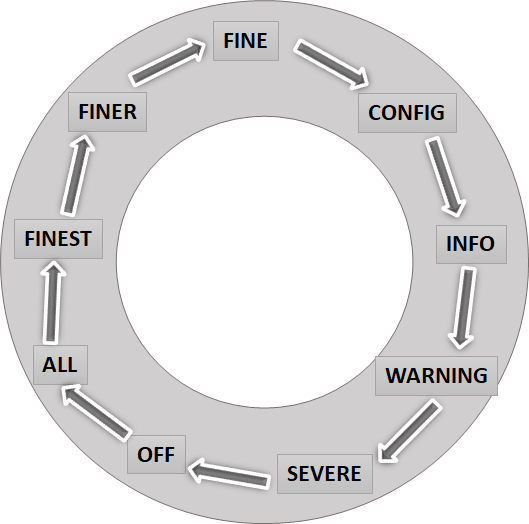
The next code snippet illustrates how one can set the log stage in Java:
logger.setLevel(Degree.INFO);
Observe that upon getting set a log stage, log messages which have a stage which is larger than or equal to the log stage specified will likely be generated. For example, because the log stage has been set as Degree.INFO right here, your software will generate logs for INFO, WARNING and SEVERE log ranges.
Learn: Logging Microservices: Challenges and Options
The best way to Create a Logger in Java
To create a logger occasion in Java you'll be able to reap the benefits of the getLogger methodology, as proven within the following code instance:
public class Writer{
    personal static remaining Logger logger = Logger.getLogger(Writer.class);
    public void displayAuthorDetails() {
    //Code shortened for brevity
    }
}
If you wish to create a customized logger implementation in Java, you must create a category that implements the System.Logger interface, which incorporates the next strategies:
- getName()
- isLoggable()
- log()
Right here is a few instance code:
public class MyCustomLogger implements System.Logger {
    @Override
    public String getName() {
        return "It is a customized logger.";
    }

    @Override
    public boolean isLoggable(Degree stage) {
        return true;
    }
    @Override
    public void log(Degree stage, ResourceBundle bundle, String message, Throwable thrown) {
        //Write your individual implementation right here to log messages
    }
    @Override
    public void log(Degree stage, ResourceBundle bundle, String format, Object... params) {
        //Write your individual implementation right here to log formatted messages
    }
}
What's a Logging Handler in Java?
A logger within the Java Logging API can have a number of handlers. When messages are logged utilizing a logger, they're lastly transmitted to the respective handlers until they're excluded by a filter or the logger’s minimal log stage. Observe which you could even add a number of handlers to a logger occasion.
A handler extracts the log messages from a logger, writes them to a terminal or file, sends them to a community logging service, transmits them to an working system log, and many others. You'll be able to deactivate a logging handler utilizing setLevel(Degree.OFF) and even reactivate it as wanted.
The next code snippet exhibits how one can add a handler to a logger in Java:
logger.addHandler(new ConsoleHandler());
Right here’s how the Handler summary class is outlined within the java.util.logging package deal:
public summary class Handler extends Object
You may also create your individual customized handler. The next code itemizing illustrates a customized logger in Java:
import java.util.logging.StreamHandler;
import java.util.logging.LogRecord;
public class MyCustomHandler extends StreamHandler
{
@Override
public void publish(LogRecord logRecord)
{
//Wrie your individual logic right here to publish the log report
tremendous.publish(logRecord);
}
@Override
public void flush()
{
tremendous.flush();
}
@Override
public void shut() throws SecurityException
{
tremendous.shut();
}
}
Learn: Prime Java IDEs and Code Editors
Understanding the Constructed-in Java Logging Handlers
Let’s now take a fast have a look at the built-in handlers and their objective. There are a number of built-in handlers in Java comparable to the next:
- ConsoleHandler
- FileHandler
- MemoryHandler
- SocketHandler
- StreamHandler
We focus on every intimately beneath.
ConsoleHandler
Because the identify suggests, the ConsoleHandler is used to log messages to System.err. It leverages a SimpleFormatter by default. You'll be able to create an occasion of ConsoleHandler as proven within the code snippet given beneath:
ConsoleHandler consoleHandler = new ConsoleHandler();
FileHandler
The FileHandler class is used to put in writing messages to a file. You need to use both a single file or a set of rotated information. Once you use rotated information, new information will likely be created as soon as the file measurement threshold is reached. You need to use the next code snippet to create an occasion of the FileHandler class utilizing its default constructor in Java:
FileHandler fileHandler = new FileHandler();
You may also reap the benefits of the opposite overloaded constructors of this class to specify sample or file measurement thresholds.
StreamHandler
The StreamHandler class within the Java Logging API is used to put in writing messages to an output stream. The next code snippet illustrates the 2 constructors of this class:
StreamHandler streamHandler = new StreamHandler();
StreamHandler streamHandler = new StreamHandler(outputStream, formatter);
Whereas the primary constructor can be utilized to create an occasion of the StreamHandler class with none output stream, the second can be utilized to create an occasion of this class with an output stream and a formatter. If you happen to use the default constructor, you must use the setOutputStream() methodology to set an output stream for the handler.
SocketHandler
The SocketHandler class within the Java Logging API can be utilized to put in writing messages to a specific community deal with utilizing a socket. The next code snippet exhibits how one can create an occasion of this class in Java:
SocketHandler socketHandler = new SocketHandler(host, port);
MemoryHandler
The MemoryHandler class can be utilized to retailer the messages in an inside buffer. As soon as this buffer is full, the previous messages are overwritten by the newer ones. The next code snippet illustrates how one can create an occasion of this class in Java:
MemoryHandler memoryHandler = MemoryHandler();
MemoryHandler memoryHandler = MemoryHandler(targetHandler, bufferSize, pushLevel);
What's a Java Logging Formatter?
A handler takes benefit of a formatter to format a message earlier than the message is logged. There are some built-in formatters in Java Logging API. You'll be able to both use the built-in formatters or create one in your personal. The next code snippet illustrates how you should utilize a customized formatter with a handler in Java.
ConsoleHandler consoleHandler = new ConsoleHandler();
consoleHandler.setFormatter(new MyFormatter());
Formatter formatter = consoleHandler.getFormatter();
Abstract of Java Logging API
The Java Logging API makes it straightforward and seamless to work with logging in Java purposes. On this article we mentioned an summary of the Java Logging API and tips on how to program it in Java. I’ll focus on extra superior logging operations utilizing this API in a later put up right here.
Learn extra Java programming and software program improvement tutorials.


0 Comments